
Summary
In 2024, despite the US reimposing broad sanctions after General License 44 expired in April, Venezuela sustained significant oil exports, higher than those in 2019 – primarily to refineries in China, India, but also Turkey, Spain, and Brazil, with additional flows to Colombia, Cuba, and Panama.
Significant quantities of Venezuelan oil were exported to Asia, in part due to temporary US authorisations, such as Chevron’s operations, and non-Western demand, although volumes faced sanctions headwinds near the end of December.
On December 16th, 2025, the US government ordered a total blockade of all sanctioned Venezuelan oil tankers entering or leaving ports, targeting Maduro’s oil revenue amid accusations of drug trafficking and asset theft.
Sanctions Enforcement
US sanctions enforcement has led to the seizure of multiple tankers engaged in Venezuelan oil exports:
- Crude Oil Tanker Skipper (IMO: 9304667), seized on December 10th, 2025, was previously sanctioned for Iranian oil smuggling on January 13th, 2025. Currently undergoing forfeiture process in Galveston Offshore, Texas,
- Crude Oil Tanker Centuries (IMO: 9206310), seized on December 20th, 2025, in a predawn operation near Venezuela; carried Venezuelan oil despite not being directly sanctioned.
- Crude Oil Tanker Bella 1 (IMO: 9230880), pursued on December 21st, 2025, off Venezuela; operating under false flag with sanctioned Venezuelan oil and added to OFAC sanctions list as of January 13th, 2025.
Venezuela Oil Tankers Overview
The Skytek platform reveals a high concentration of oil tankers clustered around Venezuela, even amid intensified US sanctions enforcement.
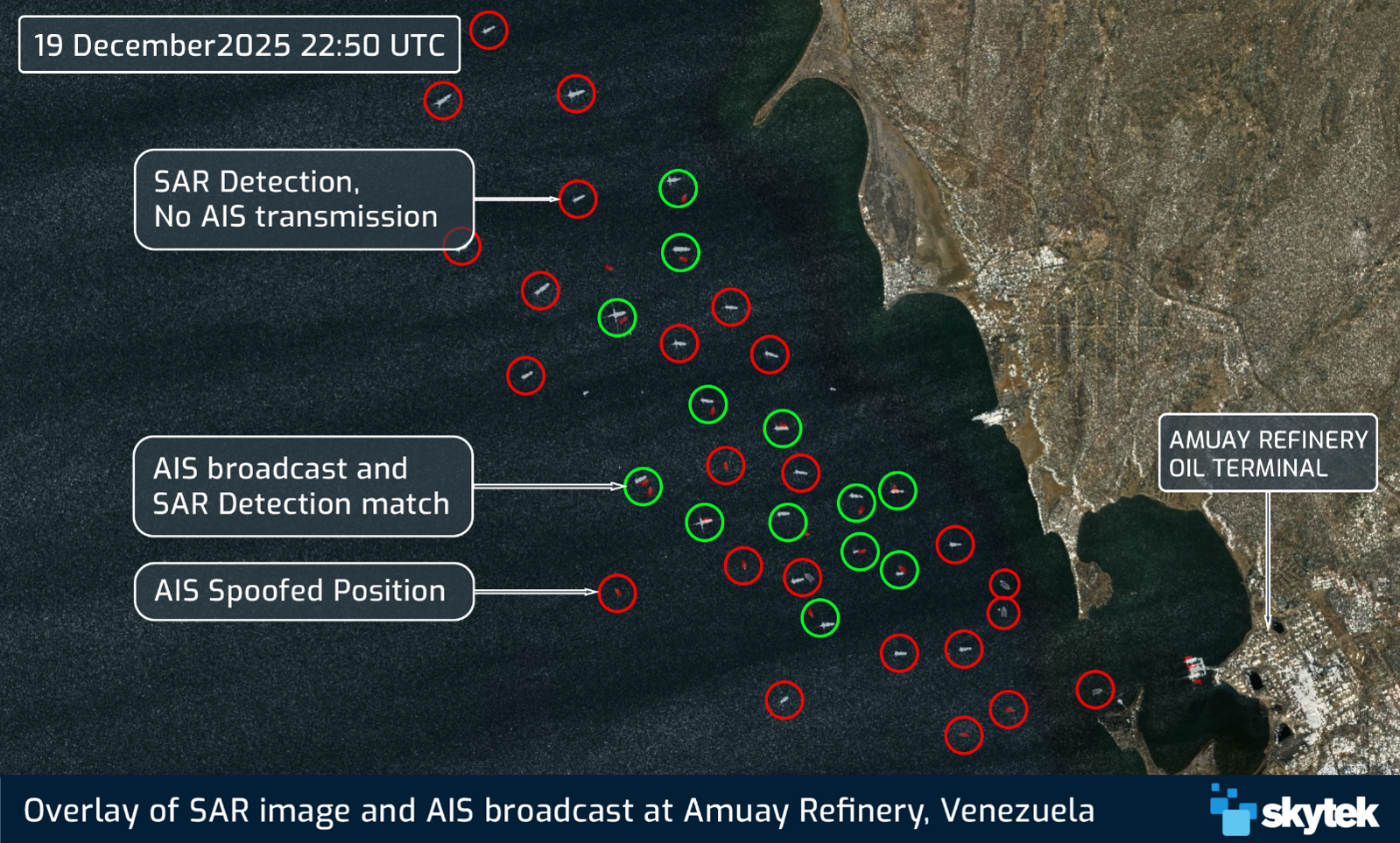
Over 70 tankers are currently loitering in Venezuelan waters, with more than half designated on the OFAC sanctions list, underscoring persistent evasion tactics. A detailed snapshot of the Amuay refinery – Venezuela’s primary oil export hub – shows dozens of tankers queued alongside or offshore, the majority operating dark (AIS-off) or broadcasting falsified identities, including spoofed positions and even IMO numbers from decommissioned “dead” vessels.
Figure 1 illustrates the December 19th scenario at Amuay refinery, where Synthetic Aperture Radar (SAR) imagery – used to detect vessels invisible to traditional AIS based tracking due to its ability to image through darkness, clouds, and jamming – is overlaid with AIS data to highlight vessels encircled in red: those transmitting no AIS signal (dark ships) or broadcasting falsified positions and identities (spoofers), thereby exposing the extent of maritime deception.
Skytek empowers marine insurers with real-time intelligence on geopolitical risk exposures, delivering actionable insights into vessel movements, fleet aggregation in high-risk zones, and claims trends. This empowers insurers to proactively address emerging regional threats, adjust risk portfolios in response to shifting geopolitical landscapes, and make well-informed underwriting decisions as global conditions evolve.


